
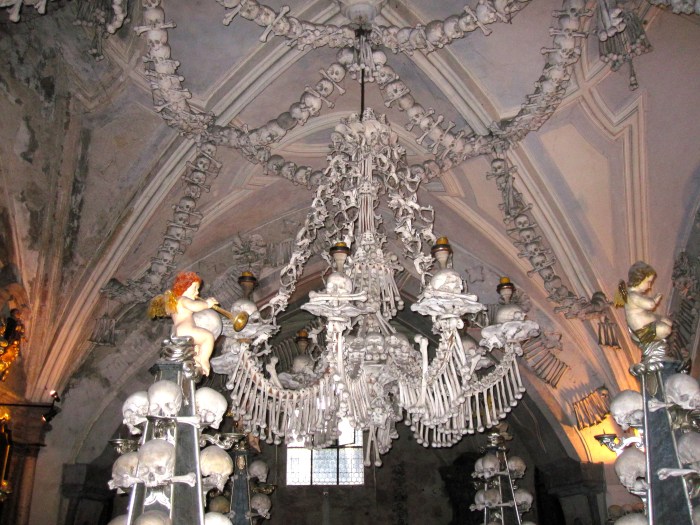
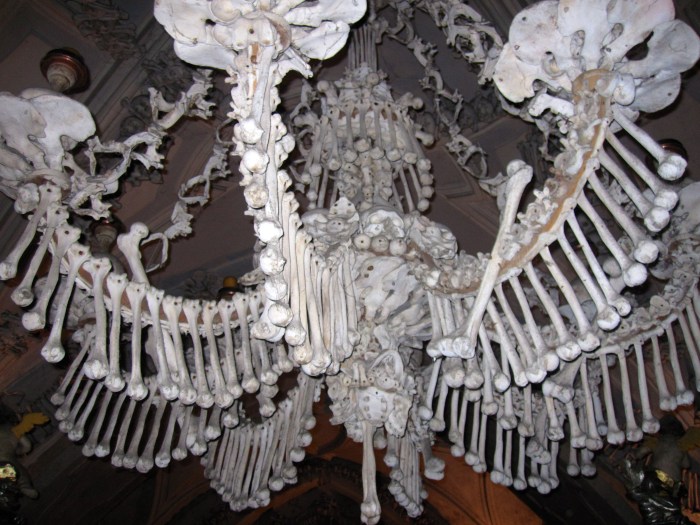
Near the end of my time in the Czech Republic, I made a trip to the Sedlec Ossuary, a small Catholic church and cemetery notable for its elaborate interior composed almost entirely from human bones: tens of thousands of skeletons, collected over 600 years, exhumed from their corpses by a half-blind monk in the 16th century, and arranged into several elaborate decorations by František Rint, a carpenter.
At the entrance, I was issued a ticket for 40 Kč (about $2.50) and I descended into the chamber, to witness exhibitionism of a radically involuntary nature.
Several hours later, I learned that Václav Havel had died, finally succumbing to lung cancer at 75. For a few months I had been absorbed in Prague’s 20th-century political drama, and few individuals influenced that narrative more than Havel. Equal part playwright, political dissident, and president, Havel witnessed the rise of totalitarian communism in the aftermath of World War II, became one of its fiercest critics, and was chosen as the country’s first elected leader after the fall of the regime in 1989.
Today he is celebrated as one of the country’s greatest heroes, but for most of his life he endured life-threatening criticism. As a playwright, he was persecuted for his absurdist, mocking portrayals of injustice and bureaucracy. As a dissident, his essays against the establishment made him its most dangerous enemy. And as president, he was criticized for not delivering prosperity through freedom fast enough.
Perhaps his idealism was not suited for the messy work of transitioning a government and economy. But please forgive my romanticism of the writer as leader.
This is the opposite of how Havel would have wanted to be remembered. He cared little for romanticisms. A writer by trade, he traded in words, and his words, against false reality as much as the Communist Party, came to define the opposition as a group of individuals simply aiming to “live within the truth.”
An early example: in his essay “On Evasive Thinking,” Havel criticized a rhetorical pattern that allowed writers to “evade” the specific, framing government failings within a falsely positive “global” context. He references a government-sanctioned editorial that minimized a death caused by a falling stone window ledge (it had not been maintained properly-by the government) by placing this single death in the context of broader social advancements.
(Imagine complaining about auto accidents! Two hundred years ago, we had no cars at all!)
This move, he argued, prevents a government official from “understanding that he bears responsibility for something and that he can’t lie his way out of that responsibility.”
Bad sentences are often forgivable, but when a second window ledge falls and kills another person, as it does in the middle of Havel’s essay, lazy writing becomes acquiescence.
***
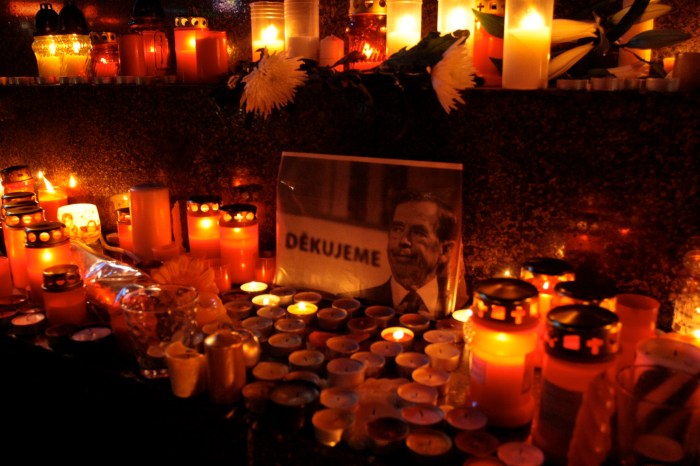
That night I returned to Prague and went to Wenceslas Square, where the Nazis held their military demonstrations, where student Jan Palach self-immolated after the Soviets invaded in 1968, and most pertinently, where demonstrations had occurred during the 1989 Velvet Revolution, which ousted the Communist Party from power.
At the time, Havel was serving a prison sentence, but protests pressured his release, and then propelled him to the presidency. In his first public address he began, “I assume you did not propose me for this office so that I, too, would lie to you.”
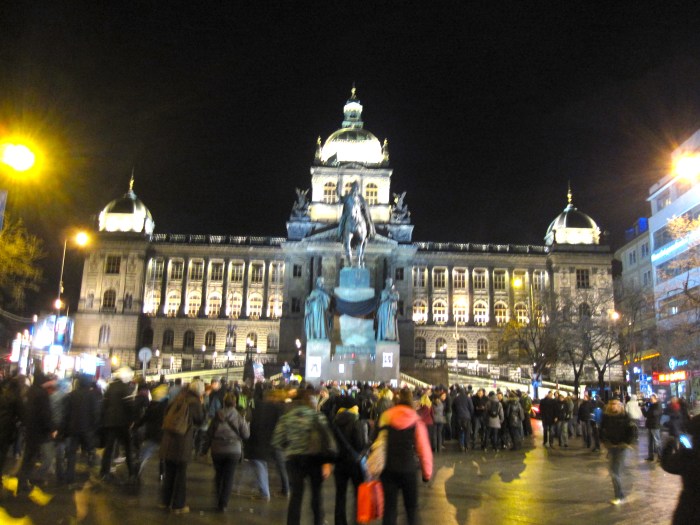
I had seen many photos of those gatherings, from WWII to 1989, and when I came out onto the square I was reminded of them, the crowds of people among thousands of candles—the colors of the Czech flag—and the only word I could think of was reverent.
Yet there was a tenuousness.
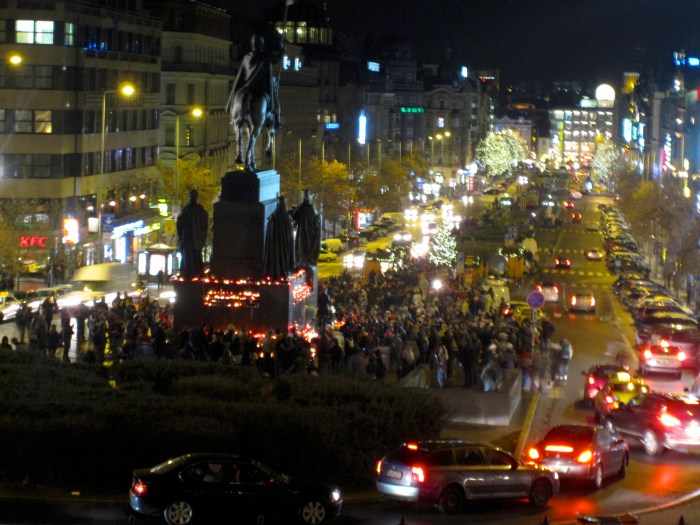
A series of speakers took turns with a mega-phone, and I could only guess at their Czech. A country that has been occupied must necessarily distrust its leaders. Despite the show trials and secret executions, several people actually told me that they had preferred communism. Democracy, they explained, had not lived up to its promise. Government was still prone to corruption. The transition to capitalism had forced many women into prostitution. The West had been idealized to such an extent that reality was a poor substitute.
The man who warned against “evasive contextualization” found himself, as president, struggling to lead after his time as a dissident, to embody the ideals he’d helped define, to remind Czechs how far they’d come.
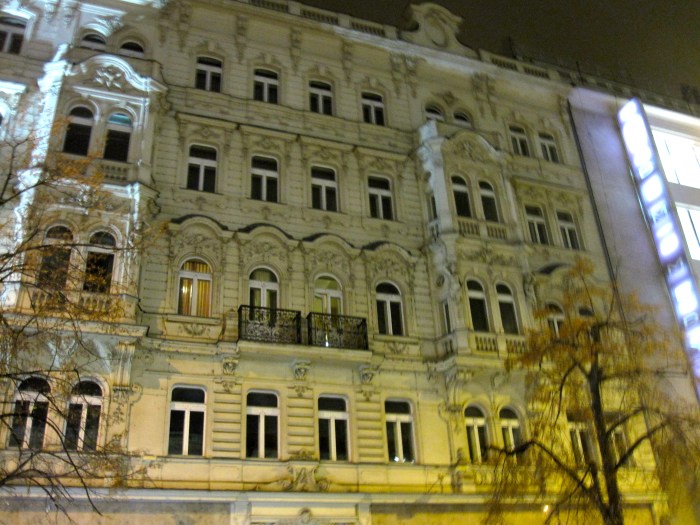
But in that moment in 1989, when Havel stood on a balcony in Wenceslas Square, he would not have discouraged their ideals. Better to remain critical, despite the length travelled, and avoid the nasty business of justifying death by window ledge. Or balcony.
In that moment they were far from that world, but my head was still buried in the medieval catacomb. František Rint had built the family crest of the Schwarzenbergs—the aristocratic house that commissioned the fashioning of the bones; that once ruled the Habsburg empire; that once defeated the Turks in a 16th-century battle at a fortress known in German as Raab, or “raven”—and consequently, the crest depicted a raven pecking out the eyes of a severed Turkish head.
This too was rendered in bone, and reflected Rint’s remarkable talent. To organize the parts of the skeleton—so that the raven could be composed of variously sized joints, and the Turk made Turkish by the placement of three smaller rib bones at the crown to mimic the style of the warrior’s braid—certainly spoke to an ethic of repurposing.
Of words, window ledges.
Havel wrote, “The same word can be true at one moment and false the next; at one moment illuminating, at another, deceptive. On one occasion it can open up glorious horizons, on another, it can lay down the tracks to an entire archipelago of concentration camps.”
The moment it falls, the stone window ledge transforms from decorative facade to object of reckoning. Where Rint was able to take death and make ornament, rhetoric took ornament and made death. If only we could all take language so seriously.
Excerpts from Havel’s speeches were taken from the following two essays: “On Evasive Thinking” (1965) and “A Word About Words” (1989), translated from the Czech by Paul Wilson and A.G. Brian, respectively, and published in Open Letters: Selected Writings, 1965-1990, edited by Paul Wilson and published by Vintage Books in 1992.
 Joe Taylor